
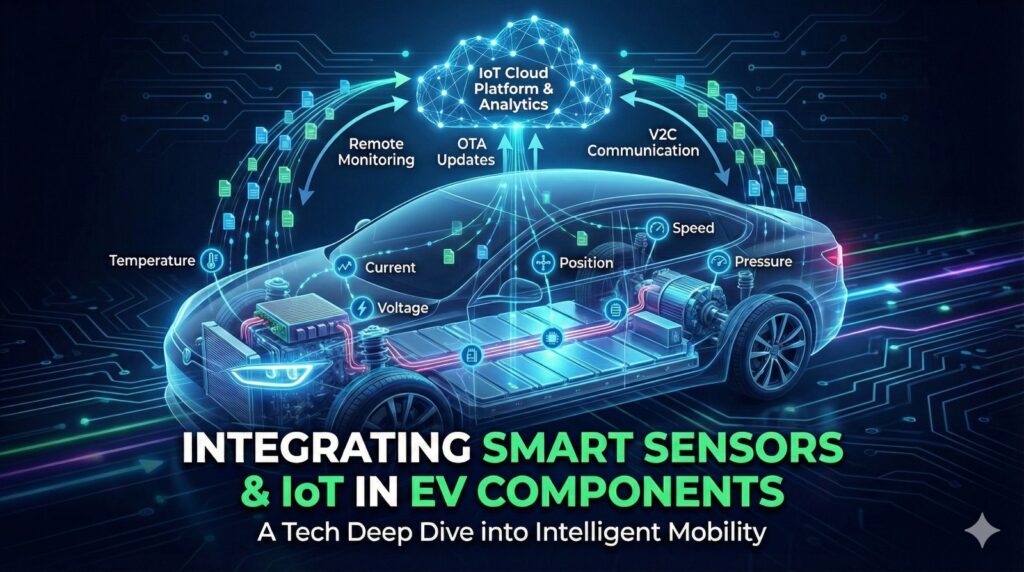
The electric vehicle (EV) industry is moving beyond electrification—it’s rapidly entering the era of intelligent, connected mobility. At the core of this transformation are smart sensors and IoT integrations, which are redefining how EV components function, communicate, and optimize performance.
At EVCOMP, India’s dedicated marketplace for electric vehicle components, we work closely with OEMs, startups, and EV system integrators who increasingly seek smart-ready components. Understanding how IoT and sensors influence EV design is crucial for building reliable, efficient, and future-ready EVs.
This blog dives deep into how smart sensors and IoT are reshaping EV components and what this means for manufacturers.
1. Why Smart Sensors Are Becoming Essential in EVs
Electric vehicles depend heavily on precision and data. Smart sensors serve as the nervous system of an EV, constantly monitoring, measuring, and transmitting critical information.
Key Reasons Sensors Matter:
- Real-Time Monitoring
Sensors provide up-to-the-second data on battery health, motor temperature, speed, torque, energy usage, and more. - Enhanced Safety
EVs require exact control over thermal limits, braking, acceleration, and battery stability. Sensors help prevent failures and increase safety. - Improved Efficiency
Smart data helps optimize power usage, reduce heat loss, and extend component life. - Predictive Maintenance
Early alerts reduce unexpected breakdowns and improve component lifespan.
2. IoT: The Backbone of Connected Electric Vehicles
While sensors gather data, IoT (Internet of Things) enables EV components to communicate, share data, and integrate with cloud platforms.
IoT Enables:
- Remote Monitoring & Diagnostics
Fleet operators and manufacturers can track EV performance in real-time from any location. - Over-the-Air Updates (OTA)
Controllers, BMS, and telematics systems can be updated without physical access. - Vehicle-to-Cloud (V2C) Communication
Critical for battery management, route planning, and performance optimization. - Data Analytics & AI Predictions
Patterns in data help OEMs improve design and deploy predictive maintenance.
3. Smart Sensors Used in EV Components
Modern EV components rely on a range of sensors to operate efficiently and safely. Some of the most widely used sensors include:
- Temperature Sensors – Monitor battery and motor temperatures to prevent overheating.
- Current & Voltage Sensors – Enable accurate energy flow measurement in battery packs and controllers.
- Position Sensors – Crucial for motor rotation and torque calculation.
- Speed Sensors – Support motor control, braking, and regenerative systems.
- Pressure Sensors – Used in cooling systems and advanced battery designs.
- IMU Sensors (Inertial Measurement Units) – Detect movement, tilt, and stability for advanced EVs and scooters.
These sensors integrate directly with EV components like BMS, controllers, motors, chargers, and telematics modules.
4. IoT-Enabled EV Components: A New Standard
At EVCOMP, we see a growing demand for components that come with built-in IoT capability. Examples include:
- Smart BMS (Battery Management Systems)
Provide real-time SoC, SoH, cell balancing, thermal data, and cloud connectivity. - Connected Motor Controllers
Support OTA updates, remote parameter configuration, and diagnostics. - Telematics Devices
Offer GPS tracking, geofencing, analytics, and fleet management insights. - Smart Chargers
Sync with mobile apps, track energy usage, and prevent overcharging. - IoT-Guided Powertrains
Allow performance tuning and predictive maintenance.
These components help EV manufacturers reduce breakdowns, improve product quality, and deliver a connected ownership experience.
5. Benefits of Integrating Smart Sensors & IoT in EV Components
Smart technology doesn’t just modernize EVs—it creates measurable gains for manufacturers, fleet operators, and end-users.
Key Benefits:
- Higher Reliability
Continuous monitoring reduces component failures. - Better Energy Efficiency
Real-time adjustments optimize power consumption. - Enhanced Safety Levels
Immediate alerts prevent overheating and electrical faults. - Lower Maintenance Costs
Predictive analytics reduce breakdown frequency. - Improved Performance Tuning
IoT feedback helps OEMs refine their EV design. - Data-Driven Product Improvement
Manufacturers can use real-world data to enhance future component versions.
6. Challenges Manufacturers Face When Adding Smart Tech
Even though the advantages are strong, integrating sensors and IoT into EV components brings several challenges:
- Higher Component Costs
Smart-ready parts can be more expensive upfront. - Data Security Concerns
Connected systems must be protected from breaches. - Compatibility Issues
Different OEMs use different protocols, requiring standardization. - Supply Chain Complexity
Finding verified, reliable IoT-ready components is still difficult in India.
7. How EVCOMP Helps Manufacturers Build Smart, Connected EVs
EVCOMP is India’s first dedicated EV component marketplace—and we’re committed to helping OEMs source reliable, verified, smart-ready components.
What EVCOMP Offers:
- Verified Suppliers
Every IoT-enabled and sensor-integrated component is carefully vetted. - Wide Component Range
Smart BMS, controllers, motors, telematics modules, connectors, sensors, chargers, and more. - Technical Guidance
Our team helps OEMs understand compatibility, integration, and performance parameters. - Local + Global Sourcing Options
Compare Indian and international components at one place. - Transparent Data & Easy Comparison
Manufacturers can analyze specs, certifications, and features instantly.
Conclusion: Smart Sensors and IoT Are the Future of EV Manufacturing
The future of electric mobility is connected, intelligent, and data-driven.
Smart sensors and IoT-integrated components are not optional—they are quickly becoming the standard for performance, safety, and efficiency.
With EVCOMP, manufacturers gain access to trusted suppliers, verified IoT-ready components, and expert support—making it easier to build the next generation of advanced EVs.
EVCOMP: Powering India’s EV future with reliable, smart-ready components.