
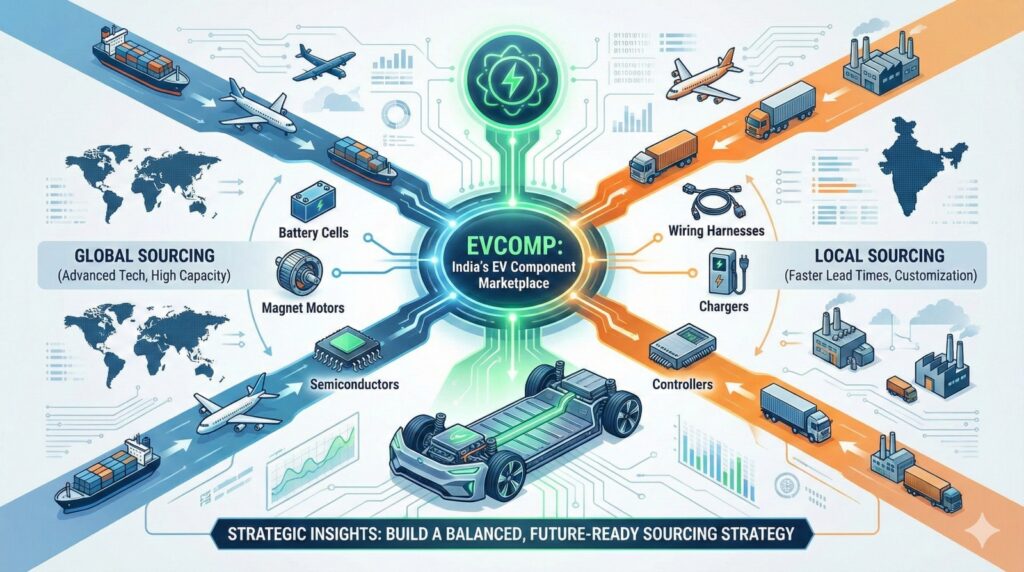
As India advances rapidly in EV manufacturing, one of the most important decisions OEMs, startups, and system integrators must make is whether to source EV components globally or locally.
This single decision affects cost, quality, supply-chain reliability, lead time, and long-term competitiveness.
At EVCOMP, India’s dedicated marketplace for EV components, we work closely with manufacturers to help them make informed sourcing decisions. This blog breaks down the pros, cons, and strategic insights behind choosing global vs local EV component suppliers.
1. Understanding Global Sourcing of EV Components
Global sourcing refers to procuring EV components from international markets such as China, Germany, Japan, Taiwan, or the United States.
Benefits of Global Sourcing
- Access to Advanced Technologies
Global suppliers often specialize in cutting-edge EV technology—battery cell chemistry, high-efficiency motors, BMS systems, and power electronics. - Higher Production Capacity
Overseas manufacturers can handle large-volume orders consistently, making them attractive for high-scale OEM requirements. - Potential Cost Advantage
Some components—battery cells, magnets, semiconductors—may be cheaper due to large-scale global production.
Challenges of Global Sourcing
- Longer Lead Times
Importing involves shipping delays, customs clearance, and documentation—resulting in slower production cycles. - Supply Chain Vulnerabilities
Geopolitical tensions, pandemics, and raw material shortages can disrupt global supply chains. - Quality Verification Issues
Without proper vetting, OEMs may face inconsistency in quality standards from overseas suppliers. - Limited After-Sales Support
Warranty claims and replacements take longer, increasing downtime.
2. Understanding Local Sourcing of EV Components (India)
Local sourcing refers to procuring components from manufacturers within India—a sector that is growing rapidly under Make in India and EV-focused policies.
Benefits of Local Sourcing
- Faster Lead Times
Quick delivery reduces inventory requirements and speeds up production timelines. - Better Communication & Support
Local suppliers offer easier coordination, faster troubleshooting, and direct service visits when required. - Customization Flexibility
Indian manufacturers are more open to co-developing custom motor specs, controller tuning, or unique BMS configurations. - Lower Logistics & Duty Costs
No import duties, shipping charges, or currency-related risks.
Challenges of Local Sourcing
- Technology Gaps in Certain Components
Some advanced components—lithium-ion cells, specialized controllers, magnet motors—may still require imports. - Limited Bulk Capacity
Not all Indian suppliers can currently meet large-scale demand. - Quality Variability
Although improving rapidly, some local suppliers still lack global-level consistency.
3. Strategic Insights: How to Choose the Right Sourcing Approach
Based on industry patterns and procurement behavior, a hybrid strategy is often the most effective. Here’s what EVCOMP recommends:
1. Source Components Locally Whenever Suitable
Ideal for:
- Wiring harnesses
- Chargers
- Controllers
- Mechanical parts
- Connectors
- Frames and enclosures
Local sourcing ensures speed, reliability, and cost savings.
2. Import Only High-Tech Components
Better imported (for now):
- Battery cells
- Advanced magnet motors
- Semiconductor-based power electronics
- Special PCB assemblies
These components may still be more advanced or more cost-effective from global suppliers.
3. Avoid Single-Source Dependency
Relying entirely on either local or global suppliers increases risk. A diversified supplier mix increases stability.
4. Use EVCOMP to Vet & Compare Suppliers
EVCOMP simplifies sourcing by offering:
- Verified suppliers (local and global)
- Technical expertise for component compatibility
- Transparent product specs
- Quality checks and certifications
- Fast procurement cycles
4. How EVCOMP Adds Value to Your Sourcing Strategy
EVCOMP is more than a marketplace; it is an enabler for EV manufacturers across India.
What EVCOMP Offers
- Access to Local & International Suppliers
Compare, evaluate, and choose reliable suppliers from India and abroad. - Verified Components
All components listed go through basic verification checks for authenticity and compliance. - Technical Support
Expert assistance in selecting motors, controllers, BMS, chargers, and other EV parts. - Optimized Procurement Process
Reduced lead times, easy documentation, and faster decision-making. - Suitable for Startups, OEMs & Fleet Operators
EVCOMP supports every stage—from prototype to mass production.
Conclusion: Build a Balanced, Future-Ready Sourcing Strategy for EV Manufacturing
Both global and local sourcing have clear advantages. Manufacturers who balance innovation, cost, lead time, and supplier diversity will stay competitive and resilient.
With EVCOMP, companies gain access to a trusted network of both Indian and international suppliers—making procurement smarter, more efficient, and future-ready.